Saturday, September 09, 2006

Appreciating Music

[ awards ]

The Hints

What started off with little teasers cleverly depicting the mysterious appearance of the letters TMA before they would vanish with the effect of a television screen turning itself off, turned into one of the most talked about events in the music industry— The Musik Awards.

The invitations were hand-delivered in a black velvet envelope-type thing that you had to open to reveal your invitation card. Plain black in colour, there were several sides to the invitation. One side had the venue and timings, another told you that the dress code was formal and the colours to be worn had to be black and white. At the end of it all was a little chair that folded out with a coloured dot. The text “we have saved a seat for you” was below the chair and the colour of the dot depicted the area you were seated in. overall the invitation was cheeky, but a welcome change from the plain card normally sent out. This also showed the attention to detail the TMA team was giving to everything related to the event.

The Ambience

Set in a location that will not be disclosed, those at the gate would effectively beep the invitation, registering your attendance, and then would let you in. An elaborate deep red carpet was laid out bordered by creatively put-together by little back-drops where some red-carpet interviews were being conducted and marble slabs with TMA slogans carved into them. The red carpet itself led to a waiting area before leading on to the main place where the TMAs were being held.

Under a large dark grey tent with a shimmering light grey canopy, the waiting area was complete with comfortable sofas, air conditioning, beautiful lights and bartenders serving drinks that seemed a brilliant combination of a pineapple margarita and lemonade. Television-familiar faces, both in the music and fashion world would arrive and chat before moving on to wherever they wanted to be seated.

Out of those who lingered on, there were some musicians who seemed to consider themselves as having star-power above the others and remained somewhat aloof, all the while checking the other attendees out. The most blatant example was of Strings, who consciously stood a little away from ‘the crowd’ —on the pretext of discussing their upcoming performance— and peered onto the rest through the shades that they were wearing indoors, at night.

The stage can be described in one word only: humongous. The backdrop was plain black and white with Motorolla (the main sponsor of the event) written on it. In a way, there being a single sponsor was a relief: one was not confronted with an array of advertisements, had there been more then one which gives a bad taste to any event. The single sponsor with the simple way in which it advertised itself: by blending into the environment by restricting its colours to black and white, and graphics to text only was actually commendable where corporate sponsorship is concerned.

The event started several hours late, which was expected, although it would be nice to see a local event start relatively on time. The various hosts of the evening were Aijaz Aslam and Sonia Khan, Hasan Shehryar Yasin and Meesha, and Faraz and Natasha, the latter two being popular VJs on The Musik.

The TMA team had done everything to ensure that nothing was left out. They mounted large plasma screens for the benefit of those who sat further away from the stage and so could easily view everything that happened. They coordinated to make sure that everyone who had to be there was seated before they started the event. What they did not do however, was pay attention to sound. The sound, during most of the event, was quite horrible.

The Performances

The show was opened by Ali Azmat crooning to Mein Challa with various models dressed in white prancing around him and the stage throughout the song. The overall choreography of this particular ‘item’ was oddly similar to last year’s New York Fashion Week, where models showed off designer outfits in the midst of singers performing on the cat-walk. Despite the similarity, the song was done nicely.

To this day, most of us are unaware as to whose outfits were being displayed, but what the hell; it was fun trying to figure out which model was wearing what. And of course, Ali’s performance was also good.

The TMAs overall consisted of live performances by Musicians, a brilliant little production depicting Faisal Qureshi and Mani’s humour, and awards being given out. Coming to the performances,

Aaroh performed a song off their new album, Raag Neela which had Farooq jumping around on the very large stage in a pair of very bright red pants. Some thought he had lost it, however, one assumes he wanted to be noticed. If that’s the case, then he was quite successful. His pants are also one of the most talked-about things since the TMAs.

Haroon Rashid performed a single off his new album, Jiya Jaey with an ensemble of heavily done up individuals who tried hard to look like they were having a good time. Some of them wore, what appeared to be dresses. Haroon performed well but he could really have done without the people who joined him.

Who can forget Annie and her thumkas, especially at the awards? Performing a remixed version of her song Mahiya, Annie arrived on stage in an ankle length black dress and showed us in person what she had been flashing us with in her music videos: her thumkas. And helping her with them were the stage dancers. One has to commend the Pakistani-Shakira on her guts to swish-swash the way she did, she beat the rest of the performers by a mile when it came to entertainment.

Performing their very popular Jhok Ranjhan, the Meekal Hasan Band —known for being finicky about the ‘sound’, and why not— managed to pull it off quite decently. Not one of their better performances, in terms of sound, but one of the best where performances at the TMA were concerned.

Even though this particular song managed to gain a lot of acclaim for its beautifully written lyrics and melody, the performance of Zinda Hoon by Strings was a bit of a letdown. maybe the fact that they are one of the best bands to every come out of Pakistani soil and that the song was the very popular Zinda Hoon, could have contributed to a rise in expectations where it’s performance was concerned. But they could have done much better. It failed to create the ‘wow’ effect that should have been; given it was Strings who was performing.

The person who easily stole the show with his surprise appearance and being backed by some of the best musicians in the country, the pioneer of pop-music, Alamgir came back with a bang. Pulling off one of the most energetic and vocally strong performances I have ever been a witness too, he had some die-hard fans jumping on their chairs and dancing to his songs. He sang, he danced, he jumped and fell and came back on his feet again, he was amazing through and through. He depicted boundless energy at four-o-clock in the morning when most people were ready to die of fatigue and lack-of-sleep. If anything, TMA really did nail ‘it’ by bringing Alamgir back. And we will forever be grateful to them for it.

The Jury

The Jury members were: Arshad Mahmud, Anwar Maqsood, Shehzad Hasan (Shahi), Nayyara Noor, Tariq Amin, Nadeem Farooq Paracha, and Asad-ul-Haq.

The Awards

Best Ballad: Yaad piya ki, Fariha Parvez

Best Album: Social Circus, Ali Azmat

Best Pop Song: Pyaar to hona he hai, Suroor

Best Bhangra Song: Saiyyan way, Shiraz Uppal

Best Rock Song: Na re na, Ali Azmat

Best Live Act (Artist): Sajjad Ali

Best Live Act (Band): Mekaal Hassan Band

Best Rising Star: Kaavish

Best Music Producer (Album): Ali Azmat for Social Circus

Best Lyricist: Sabir Zafar for Na re na

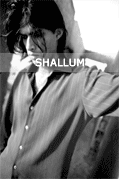
Best Guitarist: Shallum Xavier

Best Drummer: John Louis Pinto (Gumby)

Best Bassist: Sameer Ahmed

Best Keyboardist: Shuja Haider

Best Song (Viewer’s Choice): Mahiya, Annie

Best Video (Viewer’s Choice): Na re na, Saqib Malik

Most Wanted Male (Viewer’s Choice): Atif Aslam

Most Wanted Female (Viewer’s Choice): Annie

Most Wanted Band (Viewer’s Choice): Call

Best English Song (Viewer’s Choice): Leeway, Corduroy

Best Soundtrack (Viewer’s Choice): Dost – Faakhir

The Musik Award for Outstanding Contribution to Music: Arshad Mahmood

The Musik Award for Lifetime Achievement: Alamgir

Motorolla Musik Icon: Strings

At the end of it all…

Despite the little bloopers that occurred here and there (which were in any case, inevitable), The Musik Awards achieved what The IM Jazz Awards failed to: attaining a level of chic, sophistication and attention-to-detail, also known as professionalism in certain contexts.

The first ever awards to be audited, it’s a comforting to know there are awards out there where accountability is pertinent and where authenticity is stressed at. Lets hope TMA is able to establish a r

eputation that would further the validity of a TMA award.

One of the ways of judging an event is to see how it starts and ends. The TMA started by bringing on stage Pakistan’s symbolic rockstar, Ali Azmat and ended it by surprising everyone with the appearance of, as he is considered to be, the founder of the pop industry in Pakistan, Alamgir. The TMAs marked their way into Pakistan Pop History; let’s hope they can live up to the reputation they have established for themselves.

After-thought: comments on the awards

Meekal Hasan: A step in the right direction, I’d still like to see the awards focus more on the achievements of the musicians both behind the scenes and in the limelight. The music scene continues to be fashion obsessed and that is demoralising for many musicians who may not be considered cool and hip by the glitterati.

The nominations for the best drummer, guitarists etc are a welcome first step and need to be further extended so that the people who play on the hits and records of the country's stars are duly acknowledged and appreciated. Without Salman Albert there would be no Aadat and there would be no live performances if people like Pappu and Gumby were not recognised.

There also should have been a best singer and best woodwind category and there should have been best live sound engineer category too. Also some of the people nominated for the best drummer were not in any records and people like Salman and Fahad were looked over while they have been recording and playing live for ages.

There should also be a "talent deserving wider recognition" award. So that people can be aware of artistes who have major potential.

I also feel there should be a best journalist award. Just as the musicians are important so too are the people who cover and write about music.

Gumby:

Well organised and the show itself set a new standard for future performances in
Pakistan. From the shoot to the logistics, everything was well taken care off.


Imran Momina (Emu): I want to judge the judges.

You (the jury) give awards based on the work that an artiste has done that year or sometime near the year that is being judged. Sameer Ahmed, the bassist for the band Karavan who won the Best Bassist Award hasn't been in the country for the past three years. How could you give an award to someone who has not produced some concrete work in over three years? Let alone be in the same country?This means that the awards were given based on the credibility of the artiste rather then his or her recent work.

Compared to that, Khalid Khan, the bassist for Aaroh has done a lot of work in these past three years. He should have gotten the award. But he didn't.

This clearly shows that the motive behind the awards that were given was more personal in nature. I didn't get an award because I didn't do any (commercial) work in these past few years.

Shallum got the award for best guitarist even though it has been more then three years since the last Fuzon album came out and he hasn't released any record as a solo artiste since then.

And what was this about Kaavish winning the Best Newcomer award? Nayyara Noor gave the award to her son (the lead singer in Kaavish). What has Kaavish done so far? Compared to that Abbas Ali Khan should have won the award.

My point is: these awards are meant to pamper people.

If Sameer Ahmed has been playing bass for 20 years, then I have been playing keyboards for 17 years. On that basis (experience) then the Best Guitarist Award should have been Aamir Zaki.

Note:
— this is the unedited version, the published version is titled "Claps and carps"
— written under the pseudo/pen-name Band Baji

First Published:
World Music Magazine
Sept/Oct 2006

Alamgir has arrived!
[ comeback ]

The Godfather of Pop music in Pakistan, Alamgir recently performed a gig in Karachi. Courtesy of The Musik with a set designed by Omar Amanullah —inspired by Andy Warhaul’s Pop Art— Alamgir came and rocked all those present off their feet. Otherwise known as The French Kissers, a name coined by Gumby during one of their gigs at the Alliance Francaise, the band backing Alamgir included Immu, Khalid Khan, Gumby and Shallum Xavier.

The concert was opened by Aaroh who began with Sawal, and went on to perform Yaara. They dedicated Na Kaho to Alamgir and pumped up the excitement in their audience by concluding their performance with a rocked-up version of Yaad Gadoli by Abida Parveen.

In direct contrast to the high-powered performance Aaroh left with, Alamgir launched into a soft harmonica solo which launched off his first song for the evening: Shaam sey pehlay.

The concert was dominated by brilliant performances by everyone who performed: the Aaroh gang which included Farooq, Haider, Jason and Khalid along with Alamgir and The French Kissers. Each musician held their own and stood out despite having Alamgir amongst them.

On the other hand, Alamgir’s high-powered, energetic rendition of his rocked-up songs pulled the crowd back into the seventies and the eighties while still staying in the present. It was a night in which the young and the old came together and celebrated the arrival of a king that had been missing for way too long.

Note:
— photos will be uploaded soon.
— this is the un-edited version.
— th edited version is not what i would call 'me'
— written under the pseudo/pen-name Band Baji

First Published:
World Music Magazine
Sept/Oct 2006

Pakistani Potpourri
[ news bytes]

Touring for freedom

Courtesy of Sangeet Records, Call and Noori are due to perform for a ‘Freedom Tour’ in New York in October 2006. Sangeet Records, which launched Call in North America will soon be launching Roxen’s album there as well.


Making music for tomorrow
Concerning their next album, Bilal Maqsood of Strings released a statement that “The way it’s coming up, it’s very different. It’s definitely more along the darker lines. But it will take time.” Strings expects to release their album sometime in January or February next year.

Continuing their work as the Pakistani Ambassadors for UNICEF’s AIDS/HIV awareness program, they also have plans of organising concerts for this cause and possibly release a video as well.

Jamming with Shallum

Shallum had been hard at work preparing for the launch of his show, “Playing it live with Shallum” which made its first appearance on Aaj TV on Monday August 7th, 2006. Based on the concept of showing televised jamming sessions, the show depicts Shallum’s playing chemistry with other musicians.

When I grow up, I want to be a Sufi

Inspired by her collaboration with Salman Ahmed on the song Ghoom tana, Shuba Mudgal’s album The Awakening contains several songs based on the Sufi theme. Sung in high pitch, Mein sutti raiyan is one of the sufi-inspired songs in the album. Other tracks include Ali o Ali and Kar sajda.

Speaking about Sufi music, M udgal is of the opinion, “Sufi is not only music. It is like a faith, a belief and deals with man-God relationship. All Sufi songs sound like love songs. I have always been an ardent admirer of this form”.

Hadiqa collaborates with the Jogi Ranjha

The Britain-based singer K hiza who scored a hit amongst desis world wide with the release of his single, Ranjha jogi ho gaya, has collaborated with Pakistan’s very own Hadiqa Kiani on a song. Titled Mehr ma, this is the first time Hadiqa has collaborated with Khiza. The video of Mehr ma is being directed by Sohail Javed and is expec ted to be released soon.

Jjilawtan launches online radio

The Jilawatan management company has launched its own online radio. The radio is meant to stream music online 24/7 and is currently in its Beta phase. At the moment, the only options available to potential listeneres are that of having the radio streamed and of requesting a song.

Jilawatan Radio: http://www.jilawatanradio.com

LAUNCHED THIS SUMMER

The questions within

The Rushk duo, Uns Mufti and Ziyyad Gulzaar re-launched their debut album Sawal after a period of almost five years. The current re-launch as well as the initial launch of the album had been done via BMN records. The album had previously been launched in India making it unavailable for many in Pakistan till now.

Uns Muft i now currently heads his baby, the creative house Rola whereas Ziyyad Gulzaar has moved on to play with Ali Azmat as a part of his band. Ziyyad has also played on Ali Azmat’s debut album, Social Circus. This is not to say that Rushk as a band has dissolved, it is still very much there. In fact, the Rushkies would like to release a second album sometime.

Listen to me

Following the release of Abbas Ali Khan’s video Malal, depicting a vampire-dominated story line, Abbas Ali Khan has released his album titled Sun Re, named after the first video that was launched from this album. The album was released via Indispensable Communications, Tariq Amin’s record label. The cover had also been designed by Abbas and to date, this is his second album as a solo artiste.

The journey ahead
Sajid and Zeeshan also launched their debut album this summer. Titled
One light year at snail speed, the album contains songs written and composed by Sajid Ghafoor with one song, Deserts, written by Fasi Zaka. The album had been recorded at Zeepar Studios with the entire post-production work being done by Sajid and Zeeshan’s other half, Zeeshan Parwez. They intend to release their next video soon, based on a song from the album, Have to let go sometime, directed by Zeeshan Parwez.

EMI has decided to resume operations in Pakistan. Marking their comeback with Sajid and Zeeshan as the first band to sign up with them, EMI plans to incorporate anti-piracy laws introduc ed by the government and has set up a whole wing to govern their implementation.

UPCOMING ALBUM LAUNCHES

The dark side of Aaroh
Aaroh has p
lans of releasing their self-titled second album, Aaroh, this September. Initially the launch had been planned for June, but because of some unavoidable circumstances, it had to be delayed. Most of the songs in this album have been written by Haider, the lead guitarist of the band. Two videos from the new album, Yaara and Pyaar ka jaal have already been released and have been making regular rounds on the television ever since.

High on Haroon
Haroon is set to release his third album in the September this year. The album was recorded in Haroon’s Turbo Charged Funky Lil Studio in his Karachi home. The album will be called Haroon ka nasha and most of the songs in the album have written by him. The composition of the album however, has been done entirely by him.

Dominated by lots of powerful melodies, the album does not follow a particular theme with the songs exploring subjects related to love, social issues as well as peace. Asad Ahmed, the guitarist from Karavan, who used to be with Haroon previously when they were both a part of Awaz, has worked with him on the album and the acoustic guitar sound that the album embodies can be attributed to him. The keyboards had been handled by Vicky.

According to Haroon, “I’m very happy with the album. The songs have a lot of depth in them, which is very important. It is musically very powerful and has a very fresh sound.”

Mirroring the wall
Jilawata
n, the group responsible for the success of Jal before they parted ways with them, and who are currently managing Call as well, is busy nowadays in planning the release of two of the bands that they manage.

Roxen, an upcoming band that already has a little fan following, plans to release their debut album Roxen-e-deewar. Preceding the album launch itself, they plan to release the video of their song To phir aao.

Another Jilwatan project, the launch of Akash’s debut album is set to release sometime at the end of September. Their next video, Arman, directed by Xulfi is also set to be released on the tube around that time. Akash’s album is titled Aks.

Celebrities almost famous
Co
ming out from the Lahore underground, Coven has plans of releasing their album this September. Having been around longer then most underground bands, Coven is credited to have contributed greatly to the underground music scene in Lahore. Three Coven singles, Third world celebrity, Sailing fast and Boundries broken have already been released over the internet. The video of Third world celebrity, directed by Rola was nominated for a Viewer’s Choice Award at The Musik Awards.


Nowhere Land
Shahzad Hameed, also a product of the Lahore underground, plans to release his debut album titled Songs from the Nowhere Land this fall. The video of his first single, Fish out of water was released sometime in December 2005 to critical acclaim but failed to connect with mass audiences. According to media professionals, his album is brilliantly unique and holds promise. Let’s hope record companies will be able to see that.


Note: Column was written under the pseudo-name/pen-name of Band Baji

First Published:
World Music Magazine
Sept/Oct 2006

Monday, September 04, 2006

‘The Producers’ at play
The curtain rises and we are confronted with six beautiful girls, dressed in shimmering dresses, standing side by side with a comparatively older looking man in the centre. They start out singing an introductory song to the highly-acclaimed Mel Brooks play, The Producers. There are no musicians present and no band. The song plays in the background with the ensemble on stage singing along at a slightly faster pace.

They leave and the one of the lead characters in the play, Max Bialystock, bursts into the scene from under a pile of newspapers on a couch placed centre stage. The play has officially started with a most unexpected beginning: no one could have fathomed that the couch in the background had been ‘occupied’ while the choir sang. And things only got better as the night progressed.

The Producers is a well-known, award-winning (several times over) play written by Mel Brooks, based on the Academy Award winning 1968 film by the same name. The person responsible for bringing it to Karachi is Nida Butt, a human rights lawyer by profession, who has had a keen interest in drama since her college days. “I came on stage two years ago as an actress in a play and since then decided that this is something that I wanted to do. But I wanted to head my own production and this was it,” she says enthusiastically.

The Producers is a play about a Broadway producer, Max Bialystock, who manages to convince his unassuming accountant into joining him in producing a play that will be doomed to fail from the beginning. They would raise more money than needed for the play and after it does flop, they would end up pocketing the production money. The play that they end up choosing is Springtime for Hitler written by a Hitler aficionado, Franz Liebkind, keen on displaying the ‘lighter’ side of Hitler and his hidden interest in song and dance. The plan backfires and the play ends up becoming a hit with the producers, Max Bialystock and his accountant Leo Bloom, ending up in a bit of a mess.

Memorable scenes from the play include Max Bialystock’s entry and the pains he goes through to extract a check from Ms Hold-me Touch-me, and also Leo Bloom imagining himself as a Broadway producer. Ulla’s audition was definitely another entertaining moment. The actress playing Ulla portrayed the dumb-blonde cliché and was also very convincing despite being a desi in a blonde wig. Hitler enters the play Springtime for Hitler within The Producers from among the audience itself and this is accompanied by high-powered dance sequences by the cast in the final scene of Springtime for Hitler.

The cast comprised primarily of school children who were refreshingly not conscious of the audience and performed enthusiastically. The lead roles of Max Bialystock, Leo Bloom, Ulla (the Swedish secretary), Ms Hold-me Touch-me (investor), Franz Liebkind and the lead singer seemed comparatively older and mature.

Even though those performing in the choir weren’t exactly ‘singers’, the cast and crew of Made for Stage (Nida Butt’s theatrical group) have to be commended for their efforts in trying to bring the play as close as possible to its original film version. From the set design to Ulla’s famous yellow dress, every little detail had been taken care of.

Post-performance talk with Nida Butt revealed that she had begun working on the play five months prior to its launch show. “In April, I started adapting the storyline and concept and held auditions in June. Our rehearsals took place in July and August,” she said.

Elaborating on why she chose The Producers, she said, “I think there are no gaps where the storyline is concerned. The latter is simple but the characters themselves are very flamboyant. A person can find his or her own meaning from each character and it gives you much more scope and room to work with.” Made for Stage collaborated with Flame (Friends of Literacy and Mass Education) on this production. As to why she chose this particular charity, Nida said, “A mutual friend recommended me to Flame and literally everything had been decided in the first meeting. They are an excellent charity, very good and trustworthy, and are very easy to work with especially when it comes to handling the sponsors, etc.”

With the proceeds gained from this show, the charity plans to establish more schools and provide better medical facilities to the underprivileged students studying in their schools.

First Published:
Images
September 3rd, 2006

Wednesday, August 30, 2006

The technology zoo
[ Last byte ]


A non-techie
attendee at an informationation technology and telecommunication exhibition describes her enlightening experience

ITCN Asia was being held at the Expo centre in Karachi last month for three whole days and I was required to attend and get ‘educated’ on what the latest gadgets and services in information technology available in the market were.

Upon entering the Expo centre on the third day, I was pleasantly surprised to see a whole band set up at the reception. My joy knew no bounds when I assumed there was going to be live music. Upon closer inspection, my heart sank in bitter disappointment when I realised the instruments, a guitar, keyboard and drum set, were simply shells of what they were ‘supposed’ to be. I was offended at seeing that the guitar was without strings. It was an insult to the instrument itself.

Moving on, the hallway was full of blown-up advertisements of various mobile operators, mobile phone companies, television channels and maps of the exhibition. We, me and my colleagues, headed towards the area which seemed to be generating the most excitement from the crowd: the hall which hosted stalls by all the mobile operators in Pakistan.

The stalls themselves were humongous and had interesting shapes. The music playing from each stall was deafening. What was even more irritating was the fact that Telenor had Ali Zafar’s Channo on repeat mode. When it came to stall size, Mobilink beat all but failed to generate a crowd. Telenor on the other hand had everyone in the hallway going nuts. Standing on chairs, Telenor employees were throwing dozens of company-branded T-shirts, caps and badges high into the air towards the crowd and the recipients, in turn, would desperately try to catch whatever they could. Somehow it reminded me of the stories about medieval noble men throwing pieces of bread to the poor and hungry. The reaction was the same. And oh, I found out Telenor is starting a service that is faster than GPRS and would work just like a regular high-speed internet service.

A sudden, major shift in the crowd from the Telenor stall towards the Ufone stall soon revealed that Ufone was also throwing away freebies. Also present were a few Indus Music video jockeys (VJs). After a while these VJs were moved to a separate, tiny little makeshift room to be stared upon by their gaping admirers while they just sat there, had their photos taken and chatted amongst themselves. If this isn’t analogous to the modern-day zoo, where humans are both the animals on display and the spectators, I don’t know what is.

Not to be left behind, Mobilink employed a little two-wheeled cart that moved around the hall carrying their colours and logo. The person driving it looked like he was having fun. Seeing him, I desperately wanted to have a go.

The next hall we entered displayed everything related to computers, MP3 players and television sets, some from companies that I had never even heard off. What was refreshing to note was that Playdium had a stall where they had wide screens on display which some attendees were playing video games on.

Moving on, I found out that Intel had launched its second version of dual-core processor (dual-core? Wait, processor?). HP claimed to have the best PCs (the casings were amazing) and laptops in Pakistan while a relatively unknown company was giving out MP3 players via a lucky draw.

While turning round a corner, my attention was caught by 10 or 15 people, all dressed in black, wearing black caps and carrying little flags. They stopped in the middle of the hall and while waving their tiny little flags around and started to yell, “Acer! Acer!” I immediately decided never to buy an Acer product, even though I had yet to figure out what exactly they sold.

The stall that stole my heart, the products which still dance in front of my eyes and haunt me while I sleep, was Apple’s. Forget the iPods that most people, minus me, are carrying around nowadays, Apple’s MacBook looked very tempting. I’m not a Mac user, but I was ready to convert then.

One of the things I learnt was that the exhibition organisers know nothing about musical instruments or how to treat them. If I ever had my own company, I would never pull the Acer stunt and scare potential customers away and that Apple products cost three times as much as those by any other company in the same industry. Most importantly, it doesn’t matter whether you use their product or not, getting a free t-shirt from any company will, at that moment, make you happier then ever before.

First Published:
Spider
September 2006

Tuesday, August 29, 2006

Musician/Artiste: The Veronicas
Album title: The Secret Life Of The Veronicas


The Veronicas consists of twenty year old identical twins Jess and Lisa Origliasso, Australia’s answer to the Olsen twins. They entered into show biz at the age of five and "The secret life of the Veronicas" is their first attempt at releasing a debut album. Here is a quick look at the songs that stand out the most:

At first, the opening track 4ever, seems heavily inspired by an Avril Lavigne number, but that only lasts the first couple of seconds. Within moments of hitting play, you find yourself tapping your feet to a song that talks about the highs and lows of a one-sided teenage romance. The optimistic lyrics and mix of electronic with electric will find you singing this song in the shower in no time.

After the boost of energy one gets from the first track, the second track Everything I’m not is dangerously near to depressing. It speaks of insecurities that arise within a person when comparisons are made. Being twins, I’m assuming the veronicas get that a lot. For those who've always felt a little less-then-perfect, this is the song for you.

Already making waves around the world and the best song in the album, When it falls apart explores something we can all relate to: having "friends" around in good times but not knowing who to go to when things aren't so pretty. The chorus boldly asks the question, “Tell me what do you when it all falls apart?"

Even though the opening of the song is slow with minimal music, their track Secret is enough to send chills down one's spine. During the chorus however, it takes a 180 degree turn and coupled with a not-so-loud but consistently-fast drum beat the song is all about being stalked by an admirer whom you don’t like. The best part is that the girls yell back about not giving in to the pressure and stick to saying "no".

A heavy, soulful number, Heavily broken talks about relationships turning sour and the heartbreak resulting from it. Belting out lyrics "I’m heavily broken, and I don’t know what to do. See that I’m choking, and I can’t even move", it's a good song to listen to when you feel like nobody understands.

Overall the songs are preppy without having the bubble-gum effect of most pop albums. The songs are raw, personal and explore issues beyond just puppy love. Embodying a sound that is a cross between Kelly Clarkson and Avril Lavigne with a bit of electronic thrown in it, “The secret life of The Veronicas” has something more to offer then the current pop princesses making their appearances on the tube.

First Published:
Pink
August 2006

Sunday, August 27, 2006

The Producers in town
KARACHI, Aug 27: Made for Stage, a theatrical group initiated by Nida Butt, launched their first ever show based on the Mel Brooks comedy, The Producers, on Saturday.

The show had been done in collaboration with Friends of Literacy and Mass Education (FLAME) with all of the proceeds from the show going towards the FLAME fund. Currently FLAME is being headed by ex-foreign minister Mansoor Alam.

The shows are being held at The Arts Council Theatre and are expected to on till Sept 5. The opening act showed one male and several female members of the cast singing an introduction to a song playing in the background. The end of their performance marked the formal beginning of the play with McAllister, a has-been Broadway producer, bursting in to the scene from under newspapers laid out on a couch. The beginning itself was enough of an attention grabber to have the audience pay close attention throughout the play.

The play itself follows McAllister as he gets his accountant to become his accomplice in setting up a Broadway show intended to flop so that McAllister and the accountant can do away with the production money. They find a script titled ‘Springtime in Hitler’ written by a Hitler enthusiast, which explores Hitler’s not-so-famous traits: dancing and singing. The plan backfires and the show becomes a hit.

The performances by the cast members of The Producers were very good. The cast was composed of actors and actresses that didn’t look older than mere schoolchildren. The lead roles of McAllister, the accountant, Oola (the Swedish secretary) and Ms Touch-and-hold, however, were played by more mature actors. The performances overall seemed very well rehearsed and practised. Being a musical play, there weren’t many from amongst the cast who could really sing and most of the singing was supported by songs played in the background. What was even more interesting to note was that the cast-members who sang, always sang a couple of beats faster than the actual song. Overall, however, the play proved to be very well done and very entertaining.

The Producers was Nida Butt’s debut as a director-cum-producer-cum-set designer. She is a human rights lawyer with a keen interest in drama. She attributed her area of interest as a lawyer wanting to donate Made for Stage’s first performance to charity. FLAME has been actively supporting education of the poor for a very long time now and plans to establish more schools and provide better medical facilities to the underprivileged students studying in their schools from the proceeds gained from the showing of this play.

First Published:
Metropolitan, Dawn
August 28th, 2006

Thursday, August 17, 2006

The inner self interpreted

The Band:
They made a quiet appearance sometime several years ago and slipped out of the limelight without much fuss either. Those who were aware of their presence labelled their work as a product of genius and could not understand why it failed to create a bang back then. More like a project between two creative individuals, Rushk’s album Sawal — although a relatively unique piece of work where Pakistani music is concerned — went unnoticed by many after its initial launch several years ago.

Post-recording the album, the Rushk duo, Ziyyad Gulzaar and Uns Mufti were up against record companies trying to sell the concept of their music to company executives to no avail. Eventually, the album found a release in India and managed to achieve moderate success; but it did not create much of an Impact in the Pakistani market.

Those familiar with Rushk’s music blamed the album’s lack of popularity to inadequate marketing by their record label. The fact that their first ever music video —Behti Naar, directed by Saqib Malik — had been banned after receiving several months of airplay did not help things either.

Ziyyad’s portfolio as a musician includes playing for Milestones and Ali Haider before working with Ali Azmat on his solo album, Social Circus. Uns, on the other other hand, set up Rola, a ‘creative house’, which ironically ended up producing another piece of art that subsequently got banned: Joey’s Mein Nahin Hoon music video. Rushk recently relaunched their album Sawal under the BMN record label. Images decided to have a heart-to-heart with the Rushkies (a term coined by lensman Amean J) about their music, the story behind their initial album launch, what they are up to right now and where they think they are headed.

At first glance, Uns Mufi and Ziyyad Gulzaar seem like an unlikely pair: Uns is well-built, with extremely tousled hair and an eyebrow piercing, whereas Ziyyad has a very neat-looking appearance, sharp inquisitive eyes, greying hair and a moustache. During the interview, they ended up completing each other’s sentences in almost perfect synchrony.

It has been several years since Sawal’s initial launch, so why relaunch it? “This is where we were and we've moved on. The only reason we re-released is to show people or give them a point of reference that this is where we moved on from,” Uns says. “The first one has songs that amaze me even now. There are so many things that we think about when we listen to the album now. It’s a good thing because when you move beyond something, you start understanding it, deconstructing it, constructing it again in a certain way.”

So will there be a second album? “Of course. That’s why we’re sitting here,” says an apparently exasperated Uns. “In the first album, we were just getting the hang of things, but right now we’re at a point where we think we can do better.”

“It’s difficult to play this sort of music,” adds Ziyyad, talking about potential Rushk-gigs, “We have to actually think about a way to do it live. It has to be presented differently.”

“See, it’s an illusion that we’ve created. We want to hopefully, come out with an audio-visual, like a completely visual structure as well because it’s not just about him and myself,” explains Uns. “When you put producers up on stage, I guess they’ll be good at doing the music right. It has to be more than just about five guys playing in a band, because it’s not a band; it’s an idea.”

Ziyyad adds, “It’s not just about playing music and singing, which is what everyone does. We can go and play the whole album for the sake of playing the whole album, but we want it to be ‘experienced’.”

“The illusion has to be complete,” punches out Uns confidently.

There is no one way to categorise Rushk music. The closest would be to call it electronic. Uns is of the opinion, however, that “essentially, it is pop music. It’s got a pop structure in the way it’s written. The only thing is that it is subverted and it sounds like dirty pop. But it is pop and it will have grunge in there among other things. We’re at a point where

things might just come out of that pop cycle. We might just be something better and bigger. There is a possibility”.

“It’s been four or five years and we’ve started listening to different kinds

of music,” says Ziyyad.

All of the songs in the album have been sung by Nazia Zuberi; yet she is not mentioned anywhere as a part of the band. What is the story behind that? “The arrangement with Nazia was that we will give her everything from the melody, to the words, the music; and she would practice her heart out, come back to the studio, jam there and record the vocals,” said Uns. “There was always a clear understanding among us because Nazia

couldn’t commit to us. This is not what she wanted to do.” Uns further elaborated on how Rushk plans to incorporate different vocalists to sing their songs in their ‘audio-visual’ gigs.

The Videos:

Moving on, one wonders what they thought of the ban on their Behti Naar video. Conceptually brilliant but rendered in a somewhat grainy, home-produced manner, the video explores different facets of our society and selves: internal conflicts, oppression leading to rebellion, women empowerment, male submission and sexuality. Bold in it’s content and a little ahead of it’s time, Behti Naar also found Ayesha Toor (Uns’s wife) handcuffed in the beginning of the video as if haunted by internal conflicts and bound by societal rules. The handcuffs come off in the end and so does Ayesha’s hair, which is completely shorn off, possibly as a sign of liberation.

“We didn’t intend on being banned,” says Uns. “Obviously there was somebody going through the video, completely understanding it or at least relating to it somehow. I know for a fact that there are lots of people who have downloaded the video off certain sites. It is a good video to have because you can always come back to it and find something. You can find multiple interpretations. We want to move to a point where Rushk songs are open to interpretation. Right now, I feel like we’re standing at a point where everything is spelled out and you need to hold back a little.”

Rushk’s second video, Khuahish, also starring Ayesha and directed by Amean J, focuses on the war on Iraq. It begins by showing a person entering a plain white room from a blizzard raging outside. He goes through the motions of striking a match and proceeds to meticulously wear white gloves and a white mask, somehow rendering an eerily chilling effect.

Upon entering the room, we are confronted with a hooded prisoner-of-war with little tickers — that became immensely popular during the 9/11 attack on the World Trade Centre — playing across the screen. The hood is taken off to reveal a rather intimidating-looking Ayesha, who very causally asks: “Ab tumhe kya chahiye is bachay kuchey jeewan se?” Very much in-your-face when it comes to relaying the message, the shot of the supposed torturer wearing his gloves tends to haunt the viewer later on.

Director's Comments

Saqib Malik

What is the story behind the video of Behti Naar?
SM: When I first heard the song, I thought it was zara hat-kay and found out who was responsible for it. Uns and I have common acquaintances and I wanted to do a video for it. I sat down with the band and we discussed what they wanted and gave them several concepts. They wanted a video that was a little off
-beat. Also, they did not want to be featured in it.

It was an in-house affair really. Tariq (Amin) and Fariha (Altaf) are really good friends of mine and since the singer (Nazia Zuberi) had gotten married and moved aay, we cast Aisha, the woman in the video, who is Uns’s wife. The songs were hat-kay and so was the video.

What do you think of the video now?

SM: I love it (the video). It’s one of my favourites and I still believe it’s very fresh even after four or five years of being released. It’s a little hat-kay because Rushk’s music is a little hat-kay.

How do you feel about the ban on Behti Naar?

SM: It wasn’t banned. A lot of people are under that impression but it wasn’t banned. Indus Music loved the video and it was on top of their charts (than). After several months of playing it they got a phone call from some higher authority who said the material was objectionable and so they took it off air but it wasn’t banned.

It’s still played now and then on other channels.

Amean J.

What were you thinking?

AJ: A simple idea: the unfortunate invasions of the US forces.

Why the use the concept that u did?

AJ: The Khuahish video was extremely inspired by Stanley Kubrick's way of shooting films. A photographers point of view, where the camera doesn't move, instead the movement of the subject is carefullyorchestrated within the frame.

Was it the first video that you made? How was it?

AJ: I had done other video based projects in the past, but this was the first and the only music video I have done so far. it was a great experience and would like to do more story telling if I find music that will inspire me to do so'. Plus I had a fantastic team to work with, Sonya Battla did the costumes, and creative team at Nabila's did
the look that I wanted, so surely I achieved all what I wanted from the video.

*****

Coming back to the Rushkies, with a relatively good album and two off-the-centre music videos, why release it in India? “Shahi (Shehzad Hasan) who was a part of the post-production was also part of a company in India, based out of San Francisco, so he arranged it. They also played the video in India and had a marketing plan for it which I thought was really extensive”, said Uns.

But did it work? “It did what it could. BMG shut down a year after its release. Not only did they shut down, they just walked out, exited India. Right now, BMG is collaborating with Sony in India”, replied Uns. “At that time, they (BMG) were doing it with Crescendo”, added Ziyyad, “but the problem in India is, that their Bollywood music has completely...”

One would think this album would be perfectly suitable for the Indian-Bollywood market? “I sent it to Pooja Butt and her husband and they were like, ‘you didn’t release it properly’”, replied Ziyyad.

We wanted to release it properly”, said Ziyyad talking about the re-release, “I mean, we did it on tape, it was something which stuck to us, and we had to get it off our backs. Now it’s off”

“It’s not just that”, said Uns decisively, “we want to work. We want to get to work. The only way we are going to get to work is when we know the album is out in the market and whether or not people hate us or love us. We need to gauge the response in order to make a commitment for another album”.

With a market fast being saturated by new albums by even-newer artistes and so-called musicians, a need for a piece of music that stands out is direly felt. Rushk’s music may not have a direct mass appeal but it does stand out, in a good way. The idea of an audio-visual performance, given the current-embryonic stage of live music in Pakistan, seems slightly far-fetched but not entirely impossible. With videos that go beyond the cheesy entertainment factor and address issues that have long been ignored, Rushk is like a pill embedded in a chocolate bar: good for you and somewhat easy to digest.

The Album:

Sawal can easily come across as a pseudo-soundtrack. With sound effects ranging from telephone bells and radio-buzz, to a match being struck, all the songs in the album aim to create an ambience before moving on to what they really are about.

Embodying a dark melancholic, almost-romantic sound, Sawal is a major change from the confused head-banging and bhangra music that one is normally faced with when it comes to local pop music.
Nazia Zuberi hasn’t varied from more than just a couple of notes while singing, which makes the vocals a little monotonous after a while, which is somewhat disappointing, specially when confronted with the fact that she is a trained classical singer and has the capacity to hit riskier notes than the ones she has in the album.

We are faced with a duet between Ali Haider and Nazia in the track Rahen. A step away from the bubblegum-pop sound that Ali Haider has restricted himself to, it comes as somewhat of a pleasant surprise to observe that he has the versatility to sing songs from a different genre of music and pull it off well. Nazia continues to sing in monotones in this song.

Behti Naar by far dominates the album as the best track. Questioning on personal and societal identity, with a conceptually brilliant video, Behti Naar is one song that deserves to be put on play-back mode. Overall, the songs in the album tend to produce a haunting effect.

The plus points in the album are the unique sound that is Rushk, the beautifully composed lyrics, the endless questions that reflect on the inside and the very coherent way in which each syllable of each word has been rendered very coherently.

The downside can easily be that it threatens to become monotonous and that it’s not the kind of music most listeners would find very appealing. It’s the kind that needs to grow on oneself before one can begin to comprehend the content. Realising that, Sawal can prove to be an album one can listen to now and years later and not be tired of it.


Note: text in blue was edited out in the article that was published. the photos of the directors were also not published.


Photos:
1. Rushk
2. Uns Mufti
3. Ziyyad Gulzaar
4. Saqib Malik
5. Amean J.
6. Rushk album cover

Photo credits: all photos by Amean J. except Saqib Malik's photo which was courtesy of Rewaj.


First Published:
Images
August 20th, 2006

Thursday, August 10, 2006

When stars fall from the heavens

The audience of Karachi was recently witness to a concert that was déjà vu for some and history–in–the–making for all. Courtesy of The Musik and with a band consisting of the perfect line-up: Shallum on lead, Khalid on bass, Immu on keyboards and Gumby on drums, Alamgir performed some of his classics, to a fully-packed auditorium, coupled with a flavour of rock that breathed new life into his songs and made them all the more enjoyable to young and old fans alike.

With a set design inspired by Andy Warhaul’s Pop Art, the show was opened by Aaroh who had the crowd rocking to songs such as Sawal, Na Kaho (one of their more popular songs, dedicated to Alamgir), Yaara (off their new upcoming album) and a rock rendition of Abida Parveen’s Yaad Gadoli. One would think that any adaptation of an Abida Parveen song would end up a complete mess, but Aaroh pulled it off well enough to have people singing along and somewhat head-banging to a rocked up Sufi-song.

Alamgir came in the midst of resonating cheers and in direct contrast to the pumped-up energy Aaroh had left off, launched into a soulful harmonica solo which became the beginning of his song, Shaam sey pehlay ghar aajana. This was followed by Dil key sab rastey, teray hi wastey which found Shallum give into his first guitar solo of the evening, affecting Alamgir enough to have him drop on stage. In the words of Alamgir “It’s like the music of the seventies and eighties meeting with the music of 2006”

Amongst all of the songs that he performed, the most memorable were the Spanish rendition of Gauntanamera (Albela Rahi to those unaware of the source of Alamgir’s inspiration for his first ever televised song), the up-beat Sansoon Mein which had the crowd singing along, Dekha na tha in which he left the stage and joined the audience and the heart-felt rendition of his Bengali song, Aamay Bhashaili Rey during which he mimicked movements made by sailors onboard boats, and which reduced both fans and non-fans alike to tears.

Entertainer to the core, it was amazing to watch that even after all these years, Alamgir could belt out song after song, jump around the stage and feel his music with almost limit-less energy. He is one of those rare entertainers who completely shed their inhibitions and throw themselves into their songs whole-heartedly. At the end of it all, he received a standing ovation while he and his band-members bowed a final goodbye to the audience. If this writer wasn’t an Alamgir fan before, she is now.

Credits: Photo by Fayyaz Ahmed.

First Published:
Images
August 13th, 2006

Friday, August 04, 2006

Abbas and his music
In the wake of the recent terrorist attack to hit Karachi recently, Abbas Ali Khan took the bold initiative to go ahead with the launch of his much anticipated album, Sun Re. Khan is, by far, one of the first artistes to sign up with Indispensable Communication, a record label owned and operated by Tariq Amin and whose influence and control over the projection of Abbas Ali Khan’s music is very much apparent has been around for over a decade, bursting into mainstream music as a solo artiste only recently.

Previously, Abbas’s flirtation with music included being a keyboardist for a band by the name of Shor, some 10-odd years ago. The band went on to release a video which was aired at the then popular show, Music Channel Charts. Abbas was in eight grade at that time and since then, he has been very serious about music, going to the extent of training his vocals classically under the patronage and guidance of Ustaad Fateh Ali Khan.

Hosted by Tanya Shafi, the launch encompassed a mixture of live performances with a five member band with some songs being performed with a DJ and on DAT. The evening kicked off with Abbas singing a new song off his album titled Dhoondtay, a melodious number which depicted that not only could Abbas sing well, he had considerable control over the range his vocals could carry.

Having performed the first couple of songs with a live five-member band, khan teamed up with DJ Parri and later on with rapper Waleed for the song Teri Yaad, the video of which had also been released on the airwaves and has garnished a relatively good response.

Out of all the newer tracks that he performed from his album, Najaney Kyon was the most memorable with the guitarist in the song plating a major role in its overall appeal. The song, coupled with the guitar playing had an energetic feel to it that was, in its own way, very contagious.

Khan was later joined by the band that he had initially performed with and amongst the songs that were performed near the end, the Abbas Ali Khan classic, Sun Re was a treat to listen to. The track in itself has a very pleasant sound to it with catchy lyrics. It was the first song that Abbas Ali Khan had released as a solo artist and along with the aesthetically masterful video —depicting Khan with a lot of bling bling and with Tariq Amin made up as a clown— it shot Abbas to pop star status almost instantly.

On what sound his album is expected to carry Abbas commented that, “It’s a blend of different genres that I have been inspired with since childhood. We can’t really categorise this album as pop, fusion or rock, because every song has a different sound and every song tells some story about my life and incidents. I have put in my heart and soul in it and I’m sure it will affect the hearts of the listeners as will, in a positive way.”

Abbas Ali Khan is everything that a pop singer should be: he sings well and looks good while doing it. His songs don’t border on being senselessly light and happy or on the achingly depressive, but are composed of a mix that isn’t difficult to relate to and easy to digest.

With a background in training in classical when it comes to his vocals and his intense drive and focus when it comes to his music, one can surely say that we are only beginning to see the first of what Abbas Ali Khan has to offer. “I’m here to be remembered as a great artiste”, said Khan on himself as an individual within the media industry, “I’m not really running after stardom. I think if I’m true to my music and do what my soul tell me to, and if my conscience is satisfied, stardom will come eventually. I’m really satisfied will my graph of success which although has been gradual but is stable and solid”.


First Published:
Images
August 06th, 2006